Leverage is the most talked-about feature in forex and probably the most misunderstood. It is often sold as a way to make more from less, and blamed when an account empties. Neither description is quite right. This guide gives you forex leverage explained without the hype: what leverage actually does, what it does not do, how it works in both directions, and why the size of your position matters more than whether you called the direction correctly.
Key takeaways
• Leverage sets how much margin you need to open a position. It does not change what the position is worth per pip.
• Gains and losses are calculated on the full position, so leverage magnifies both equally.
• Effective leverage, your total position size divided by your equity, is the number that tells you how exposed you are.
• Higher maximum leverage does not make a trade riskier by itself. A bigger position does.
• Size each trade from the amount you are prepared to lose, then check the margin, not the other way round.
What is leverage in forex?
Leverage in forex lets you control a position larger than the money you put up. It is written as a ratio: at 1:100, every $1 of margin controls $100 of currency. Leverage decides how much margin a trade needs. Your profit or loss still depends on the full size of the position.
What leverage is: a margin requirement
Leverage and margin are the same number, read two ways
When you open a trade, part of your account is set aside as margin, a good-faith deposit that keeps the position open. The formula is: margin = position value/leverage. One standard lot of EUR/USD is 100,000 euros. With EUR/USD at 1.0850, that position is worth $108,500. Here is the margin it needs at different leverage ratios:
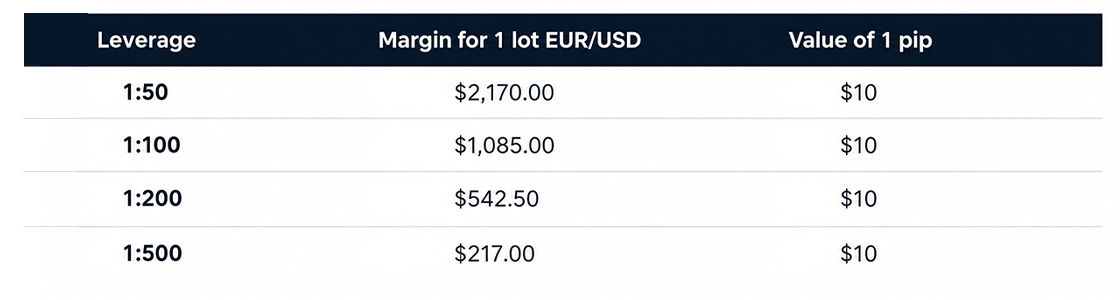
Look at the last column. The pip value never changes. Whether the trade ties up $2,170 or $217, every pip is worth $10, so a 50-pip move is $500 either way. Leverage changes the deposit, not the stakes.
How MT5 shows it
In MetaTrader 5, the Trade tab at the bottom of the screen shows three figures that matter here:
• Equity: your balance plus or minus the profit or loss on open trades
• Margin: the amount currently set aside for open positions
• Free margin: equity minus margin, which is what is left to open new trades or absorb losses
What leverage is not
Most of the confusion around leverage comes from four common misreadings.
• It is not extra money. Leverage does not add anything to your balance. Every loss on a leveraged position comes out of your own equity.
• It is not, by itself, a measure of risk. One lot at 1:50 and one lot at 1:500 make or lose exactly the same amount per pip. What changes your risk is how many lots you trade.
• It is not a one-way multiplier. Leverage is marketed for the gains it makes possible, but it applies with equal force to losses.
• It is not a target. A maximum of 1:500 is a ceiling on how large you can go, not a recommendation to go that large.
Leverage works in both directions
Take a $2,000 account and a 50-pip move on EUR/USD, which is an ordinary day’s range for the pair. Here is what that move means at four position sizes:
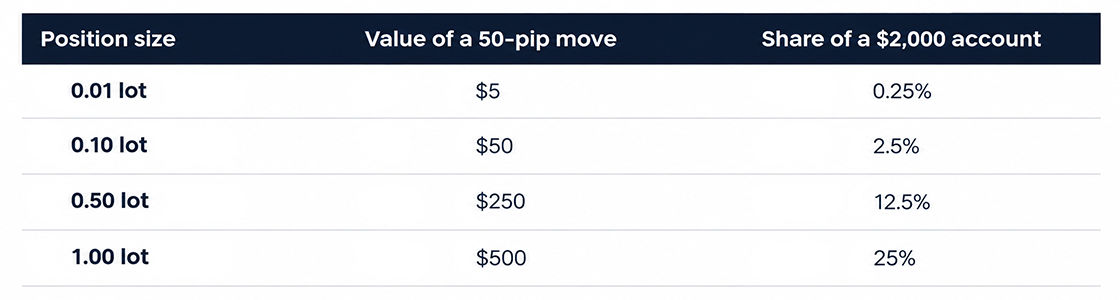
Each figure in the last column can be a gain or a loss, depending only on direction. At one lot, a single ordinary day can add a quarter to the account or remove a quarter from it. The leverage setting on the account did not decide which row you were on. The position size did.
Effective leverage: the number that actually matters
Your account has a maximum leverage, the most it will allow. What you are actually using is your effective leverage: total position value/account equity. Using the same $2,000 account:
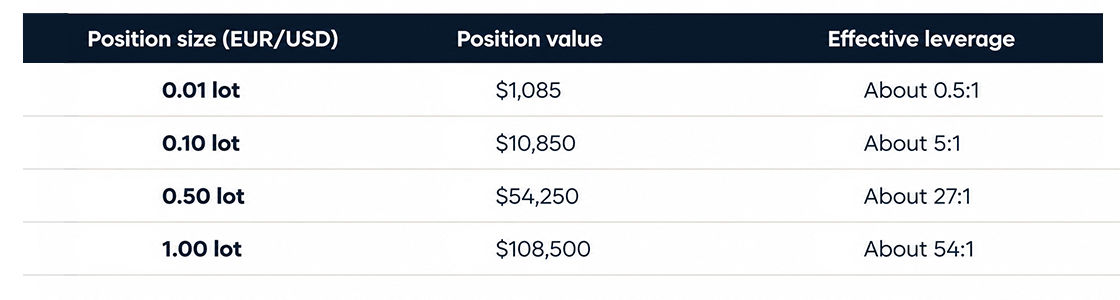
Two traders on 1:500 accounts can be running completely different levels of risk. One may be at 3:1 and the other at 50:1. The account setting is the same; their exposure is not. Effective leverage is the honest measure, and it is worth calculating before every trade.
Why size matters more than direction
Being right is not enough
A trader can read the market correctly and still lose. Prices rarely move in a straight line. If a position is so large that a normal pullback of 30 or 40 pips does serious damage to the account, the trader may be forced out by a stop-loss or plain nerves before the expected move arrives. The direction was right; the size made it impossible to wait.
The reverse is also true. A trader who is wrong but sized small loses a small, planned amount and stays in the game for the next idea. Over many trades, survival comes from size, not from being right every time.
The arithmetic of recovery
Losses and gains are not symmetrical. After a loss, you need a larger percentage gain on a smaller balance to get back to where you started:
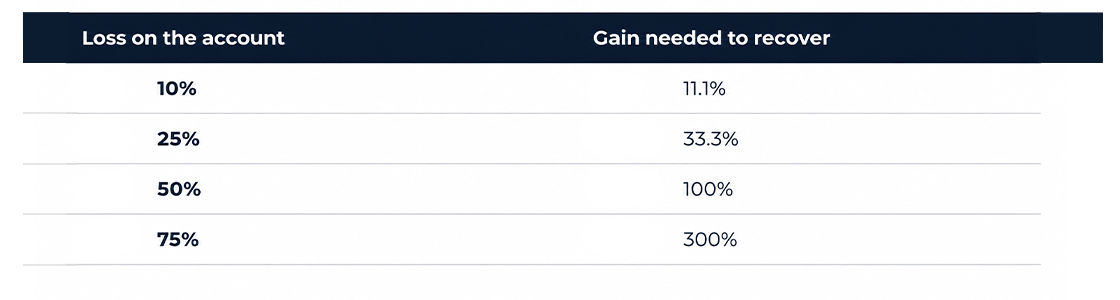
Small losses are easy to recover from. Large ones are not. Oversized positions are how small mistakes become large losses, which is why size is the first decision in every trade.
Size the trade from risk, not from leverage
The most reliable way to control leverage is to ignore it at first. Start from how much you are prepared to lose on the trade, then work out the size:
Lot size = (account equity x risk per trade) / (stop-loss in pips x pip value per lot)
Say you have $2,000, you are prepared to risk 1% on this trade ($20), and your analysis puts the stop-loss 40 pips away. On EUR/USD, a pip on one lot is worth $10:
1. $20 / (40 pips x $10) = 0.05 lots
2. Margin at 1:200: about $27
3. Effective leverage: about 2.7:1
4. Loss if the stop is hit: $20, as planned
Many traders cap the risk on any one trade at a small, fixed share of their account, often 1% to 2%. The right figure is personal, but the method is the same: risk first, size second, margin last. Leverage then becomes what it should be, a way of freeing up capital, not a reason to trade larger.
Leverage on other markets
Leverage applies to every leveraged product, but the maximum often differs by market. Metals, indices and commodities can move further in a day than major currency pairs, so their maximum leverage is frequently lower. At Arabian Markets, maximum leverage is up to 1:200 on the Basic account and up to 1:500 on Standard, Platinum and Premium; some instruments carry lower limits, which are shown in each instrument’s contract specification in MT5. The Accounts page compares the four account types.
Remember too that leverage multiplies trading costs just as it multiplies results, because spreads, commission and swaps are charged on the full position. Our guide to spreads, swaps and fees explains how each one is calculated.
Your leverage checklist
1. Decide the amount you are prepared to lose before you look at the margin.
2. Calculate lot size from that amount and your stop-loss distance.
3. Check the effective leverage of all open positions together, not just the new one.
4. Keep plenty of free margin so ordinary price swings never force your hand.
5. Check the maximum leverage for each instrument you trade, not only for currency pairs.
Leverage is neither the shortcut it is sold as nor the villain it is blamed for. It is a setting that decides how much capital a trade ties up. What happens to your account depends on how large you trade, and that decision is always yours.
Frequently asked questions
Is higher leverage riskier?
Not on its own. One lot makes or loses $10 per pip on EUR/USD whatever the leverage. Higher leverage becomes riskier when it is used to open larger positions, which is why effective leverage is the measure to watch.
Does leverage change the value of a pip?
No. Pip value depends on the instrument and your position size. Leverage only changes the margin needed to open the position.
What is the difference between leverage and margin?
They describe the same thing from two sides. Leverage is the ratio, such as 1:100. Margin is the amount of your money set aside to open the position, calculated as position value divided by leverage.
What leverage should a beginner use?
There is no single right ratio. A more useful approach is to keep effective leverage low and risk only a small, fixed share of the account on each trade. Practising on a demo account first helps you see how margin behaves.
Does leverage affect my trading costs?
Not directly. Spreads, commission, and swaps are charged on the full position, so one lot costs the same whatever your leverage. Trading larger because leverage allows it is what raises your costs.
Is the maximum leverage the same on every instrument?
No. Metals, indices, and commodities often carry lower maximum leverage than major currency pairs. Each instrument’s limit is shown in its contract specification in MT5.
Risk warning: Trading leveraged products such as forex and CFDs carries a high level of risk and may not be suitable for every investor. You may lose some or all of your invested capital. This article is for educational purposes only and is not investment advice. Arabian Markets Ltd is licensed by the Financial Services Commission, Mauritius (licence GB26206439).